
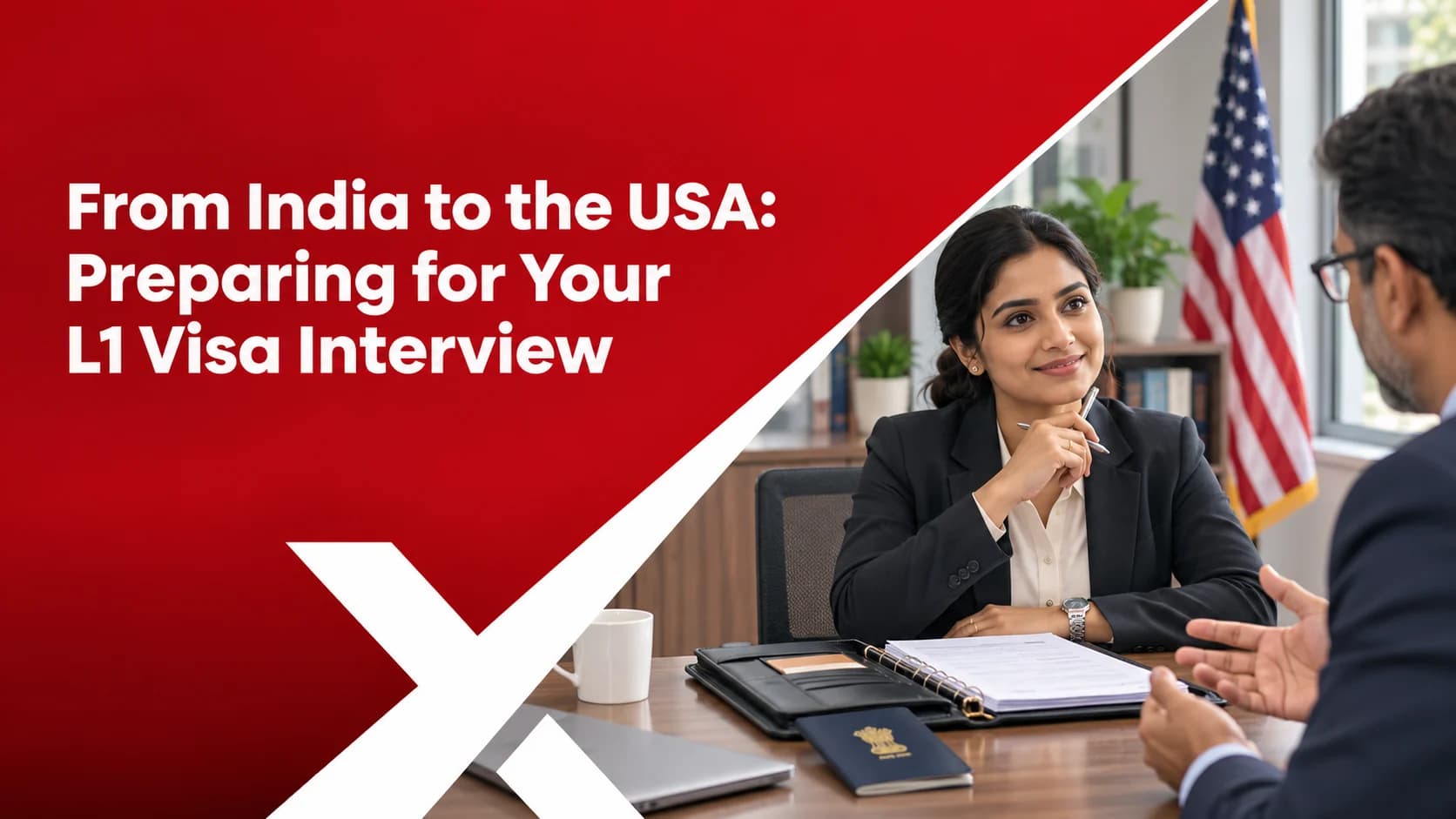
Preparing for an L1 visa interview starts with understanding your transfer, your employer and the work you will perform in the United States. Your answers should explain your actual responsibilities clearly and remain consistent with your application.
This FAQ guide covers questions Indian applicants can prepare for, with separate guidance for L1A managers and executives and L1B specialized knowledge employees.
1. What is the purpose of an L1 visa interview?
The consular officer assesses whether you qualify for the visa and whether your proposed work fits the L1 category. Questions may cover your overseas employment, the relationship between the companies and your intended U.S. assignment. An approved petition does not guarantee visa issuance.
2. What is the difference between L1A and L1B interview questions?
L1A questions focus on managerial or executive responsibilities. Be prepared to explain your decision-making authority, reporting structure and the work performed by your team.
L1B questions focus on specialized knowledge. You should explain the knowledge you possess, how you acquired it and why the proposed U.S. position requires it. USCIS
A designation alone does not explain your eligibility. Describe what you actually do.
3. What common L1 visa interview questions should Indian applicants prepare for?
Useful practice questions include:
- Which company do you currently work for?
- When did you join the company?
- What are your current responsibilities?
- How are the Indian and U.S. companies related?
- Why is the company transferring you?
- What will you do in the United States?
- Where will you work, and who will supervise you?
- What salary will you receive?
- How long is your proposed assignment?
These are preparation prompts, rather than a fixed interview script. The officer may ask different questions based on your case.
4. How should I answer “Why are you going to the United States?”
Explain the business purpose of your transfer and your proposed role. Avoid a vague answer such as “for better opportunities.”
An illustrative answer could be:
“My employer is transferring me to its U.S. subsidiary to manage the regional sales function, supervise the sales managers and oversee the department’s approved business targets.”
Use this structure only if it accurately reflects your position and petition.
5. How should I explain my current job?
Start with your designation, then describe your main responsibilities in everyday language.
For example, instead of saying, “I handle business operations,” explain which functions you oversee, which decisions you make and who carries out the operational work.
Prepare one genuine example that demonstrates your responsibilities. This could involve approving a departmental budget, directing a manager or applying specialized technical knowledge.
6. What should L1A applicants know about their team?
Review your organizational chart and understand:
- Your direct and indirect reporting relationships.
- Your team members’ designations and responsibilities.
- Your authority over staffing, budgets or departmental decisions.
- Which employees perform routine operational tasks.
Explain your actual authority without overstating it. If a hiring decision requires additional approval, describe that process accurately.
7. How should L1B applicants explain specialized knowledge?
Explain the knowledge in terms someone outside your profession can understand.
A useful structure is:
- What you know: Identify the company’s product, system or process.
- How you learned it: Explain relevant training and experience.
- How you use it: Describe a specific business application.
- Why the U.S. role needs it: Connect your knowledge to the assignment.
Simply stating that a product is unfamiliar to Americans is insufficient. The explanation must address the applicable specialized knowledge standard. USCIS
8. How do I explain the relationship between the Indian and U.S. companies?
Know the companies’ exact legal names and the qualifying relationship, such as parent and subsidiary, branch or affiliate.
Do not describe them merely as “business partners” if the petition relies on a specific ownership and control relationship. L1 classification requires a qualifying connection between the entities. L VISAS
If you are uncertain about the structure, clarify it with your employer before the interview.
9. Which documents should I prepare?
Follow your appointment instructions and your employer’s case-specific checklist. Core documents generally include:
- Valid passport.
- DS-160 confirmation page.
- Applicable fee receipt.
- Petition details and approval documentation, as appropriate.
- Form I-129S for applicants applying under a blanket L petition.
- A compliant printed photograph if required.
Additional supporting records may include employment letters, salary records, organizational charts and assignment details. These are case-dependent, rather than universally mandatory. travel.state.gov
Organize documents so you can locate a requested item quickly.
10. Is a blanket L interview different from an individual L interview?
Yes. An individual petition generally involves USCIS approval for the named employee before the visa application. Under a blanket petition, eligible employees apply using the company’s blanket approval and their individual supporting documentation.
Blanket approval does not automatically establish every employee’s eligibility. Confirm the correct process with your employer’s immigration team. L VISAS
11. Should I memorize answers?
Prepare the facts, rather than memorizing a script.
Practise explaining your role, company relationship and assignment naturally. Answer the question directly, then add relevant detail when needed. If you do not understand a question, politely ask the officer to repeat or clarify it.
Do not invent a figure or responsibility to make an answer sound stronger.
12. What if my job title or salary has changed?
Inform your employer’s immigration team before the interview. A change may need review to determine whether updated documentation or another action is necessary.
Do not conceal the change or repeat outdated information simply because it appears in an earlier document. Your answers should accurately explain the circumstances.
13. Can I discuss future green card plans?
Answer truthfully if asked. L1 permits dual intent, so pursuing permanent residence does not automatically prevent L1 eligibility. However, a green card requires a separate legal process and is not guaranteed by an L1 approval.
Avoid rehearsing a false statement that you have no immigration plans.
14. What mistakes should I avoid?
Common preparation mistakes include:
- Giving answers that contradict the DS-160 or petition.
- Confusing managerial authority with routine operational duties.
- Using technical jargon without explaining its meaning.
- Exaggerating team size, experience or responsibilities.
- Relying on another applicant’s answers.
- Assuming confidence can replace supporting evidence.
Preparation should help you communicate your genuine circumstances accurately.
15. Does premium processing guarantee a quick visa decision?
No. Premium processing concerns the eligible USCIS petition stage. It does not guarantee an interview appointment, visa issuance or completion of any additional consular processing within the same timeframe.
Applications can require further administrative processing after the interview. Avoid final travel commitments before visa issuance.
16. How can I prepare in the final days before the interview?
Review your DS-160, petition summary, assignment letter and organizational chart with your employer or immigration attorney. Confirm important dates, salary details, work location and reporting relationships.
Practise answering questions aloud using short, factual explanations. Keep your documents organized and follow the appointment instructions carefully.
Disclaimer: This article provides general information and is not a substitute for legal counsel. Requirements and procedures may change. Consult a qualified U.S. immigration attorney for advice on your circumstances.

