


Key Highlights
- An investor visa can help qualified foreign investors build a future in the United States.
- The EB-5 path is tied to minimum investment rules and clear job creation requirements.
- EB-5 may lead to permanent residency for you and eligible family members.
- Investment amounts differ by visa type, structure, and project location.
- Some routes offer green cards, while others provide temporary status only.
- Choosing the right option depends on your goals, timeline, and preferred business role.
Introduction
Navigating the path to U.S. residency can be exciting yet challenging, especially for foreign investors. With multiple options available, it’s essential to understand the various investor visa categories designed to facilitate immigration for those looking to establish or expand their businesses in the United States. Each visa type, whether it’s an EB-5 or E-2, comes with its requirements and benefits that cater specifically to the needs of investors. This guide aims to provide clear insights into each visa option, helping you make informed decisions on your investment journey.
Understanding Investor Visa Options for Indians
Several pathways exist for Indian nationals seeking investment-based immigration to the United States. The EB-5 immigrant investor program stands out with its potential for permanent residency through significant capital investments that promote job creation. Similarly, the E-2 treaty investor visa caters to investors from treaty countries, providing opportunities for establishing or purchasing businesses in the U.S. Understanding each visa’s distinct benefits, eligibility criteria, and requirements ensures that prospective applicants can make informed decisions that align with their financial goals and aspirations for permanent resident status. Exploring these options can pave the way for a successful U.S. journey.
Overview of US Investment-Based Visas
Investment-based visas in the United States offer foreign nationals a pathway to achieve permanent residency through various programs designed to encourage economic growth and job creation. Prominent options include the EB-5 immigrant investor program, which necessitates a significant capital investment in a new commercial enterprise, either through direct investments or regional center projects. Other pathways, like the E-2 treaty investor visa, cater specifically to entrepreneurs who wish to develop their businesses. Each visa category has distinct eligibility requirements, making it essential for applicants to align their business goals with the appropriate visa option.
Key Differences Between EB-5, L-1A, EB-1C, EB-2 NIW, E-2, and E-1
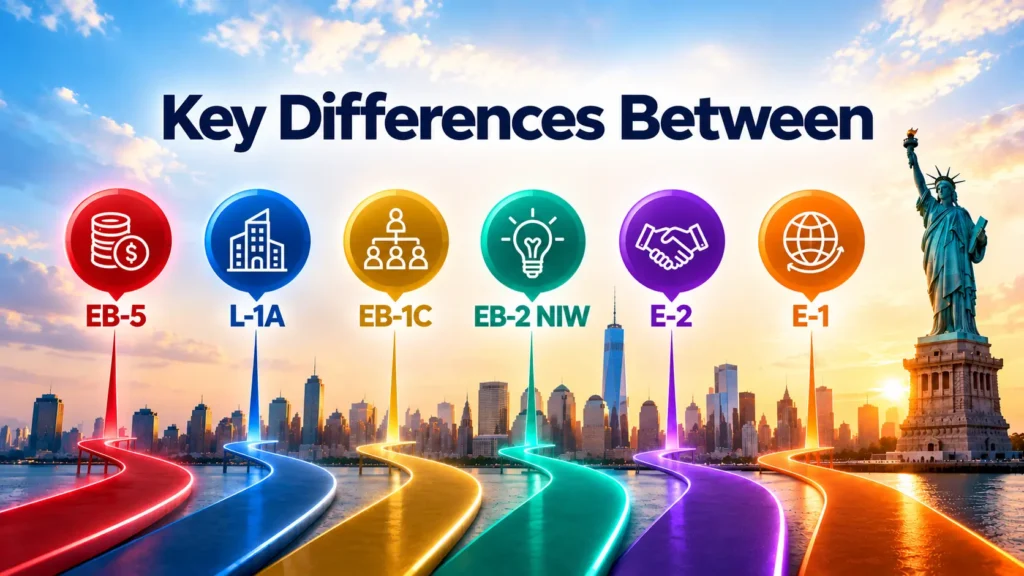
Aiming for U.S. residency through investment presents various visa options, each tailored to unique circumstances. The EB-5 visa targets immigrant investors focused on creating jobs, while the L-1A visa is designed for intracompany transferees in managerial roles. The EB-1C caters to multinational managers or executives, and the EB-2 NIW optimizes benefits for those whose work serves the national interest. Meanwhile, the E-2 and E-1 visas appeal to treaty investors and traders, respectively. Understanding these distinctions helps applicants navigate the complexities and choose the best pathway for their goals.
Why Indian Nationals Are Considering US Investor Visas
Increased opportunities and economic stability are major draws for Indian nationals considering investment-based visas in the United States. By participating in programs like the EB-5, many seek to gain permanent resident status while contributing to job creation and economic growth. Additionally, U.S. residency opens doors for education and career prospects for families, enhancing their overall quality of life. Many also see these visas as a pathway to diversification of their investments, whether through real estate or commercial enterprises, making the U.S. an attractive option for foreign investors looking to expand their horizons.
Introduction to EB-5 Investor Visa
The EB-5 Investor Visa offers a unique pathway for foreign investors to gain permanent residence in the United States. By investing in a new commercial enterprise that meets specific requirements, individuals can help stimulate economic growth and create jobs for U.S. workers. This visa not only provides investors with a chance for a better quality of life but also opens doors for their immediate family members. Understanding its benefits and requirements is essential for those looking to navigate the complexities of the U.S. immigration system efficiently. Get ready to explore this exciting opportunity!
How the EB-5 Visa Works for Indian Applicants
Navigating the EB-5 visa process can seem overwhelming for Indian applicants, but it presents an exciting pathway to U.S. residency. This immigrant investor option requires a qualifying investment in a new commercial enterprise, typically amounting to $1.05 million or $800,000 in a targeted employment area. By creating or preserving at least ten jobs for U.S. workers, applicants can seek a conditional green card. Once the conditional status is granted, investors must demonstrate the lawful source of funds and fulfill job creation requirements to transition to permanent resident status. The simplicity of concurrent filing allows eligible applicants to secure their immigrant petition while applying for a visa simultaneously, providing a streamlined approach to the immigration journey. For Indian nationals, the prospect of comprehensive legal services and free consultations can simplify the application process and enhance chances of success.
Benefits of the EB-5 Program
The EB-5 program offers a pathway to permanent residency in the United States through capital investment in job-creating projects. This visa grants foreign investors and their immediate family members the opportunity to obtain a green card while contributing to economic growth. In addition to direct investments, participants can leverage regional centers, which provide a more streamlined approach to qualifying projects. With the potential for expedited processing and the ability to reside in various U.S. states, the EB-5 program stands out as a viable option for individuals seeking long-term residency and business opportunities in America.
The E-2 Treaty Investor Visa – Opportunities & Limitations
This visa offers a wonderful pathway for foreign investors seeking to establish a business in the United States. The E-2 treaty investor visa allows individuals from qualifying countries to invest in a new commercial enterprise, often facilitating job creation and economic growth. However, limitations exist, such as the temporary nature of this visa and the requirement for substantial capital investment. Additionally, dependents may accompany the investor, but converting to permanent residence is not straightforward. Understanding these aspects is crucial for making informed decisions about pursuing the E-2 investor visa opportunity.
Countries Eligible and Impact on Indian Applicants
The landscape of investment-based visas is influenced by specific treaties between the United States and other countries. Countries that share trade agreements or treaties with the U.S. often enjoy eligibility for visas like the E-2 treaty investor visa. For Indian applicants, this creates a unique opportunity — while India does not have an E-2 treaty, India’s growing trade partnerships could eventually change that scenario. Understanding these nuances can help Indian investors navigate options more effectively, ultimately enhancing the prospects of achieving U.S. residency through alternative pathways like the EB-5 program.
E-2 Visa Requirements and Application Steps
The e-2 visa requires applicants to have a substantial investment in a U.S. business. This investment should be sufficient to ensure the enterprise’s success and demonstrate the ability to generate jobs for U.S. workers. Key steps in the application process include compiling a comprehensive business plan, detailing your investment and its source, and filling out the necessary forms, such as Form DS-160. Interviews at U.S. consulates may be part of the process. Maintaining a proactive approach can streamline the application, ensuring all documentation is in order for a smooth experience.
L-1A Intracompany Transferee Visa Explained
This visa category is designed for foreign nationals who hold managerial or executive positions within their companies. The L-1A allows these individuals to transfer to a U.S. branch, affiliate, or subsidiary, facilitating the growth and stability of international business operations. Essential to this process is demonstrating a qualifying business relationship, ensuring strict compliance with job creation requirements. Among its many advantages, the L-1A provides a pathway to permanent residency, making it an attractive option for those aiming to establish a long-term presence in the U.S. and contribute to economic growth.
Qualifying Business Relationships for L-1A
To successfully apply for an L-1A visa, establishing qualifying business relationships is essential. This involves demonstrating a direct affiliation between your foreign company and its U.S. counterpart, which can be achieved through ownership or control. The U.S. entity must be a subsidiary, parent, or affiliate of the overseas business. Additionally, you’ll need to show that both firms are operational and engaged in legitimate activities. Meeting these criteria is crucial not only for visa approval but also for compliance with job creation and investment regulations specified in U.S. immigration policies.
L-1A Application Timeline and Process
Understanding the L-1A application timeline is essential for a smooth transition. After gathering the necessary documentation, including an immigrant petition and relevant business plans, submitting your application to U.S. immigration services typically takes about 2 to 4 months for processing. Following approval, if applying from abroad, consular processing may add additional weeks. Concurrent filing can expedite the adjustment of status, allowing immediate family members to access employment authorization documents. Staying proactive in communication with your legal team ensures you are informed every step of the way, allowing you to focus on your new venture in the United States.
EB-1C Multinational Manager or Executive Green Card
The EB-1C Multinational Manager or Executive Green Card is a stellar pathway for qualifying foreign nationals aiming for permanent resident status in the United States. This visa category benefits those who have been employed in managerial or executive roles abroad and are looking to establish or expand their business in the U.S. Employment-based preferences ensure that applicants demonstrate their leadership capabilities, furthering economic growth and job creation. Importantly, this visa streamlines the transition to lawful permanent residence, providing a smoother path toward long-term stability and opportunity in the American market.
Criteria for Indian Professionals and Entrepreneurs
For Indian professionals and entrepreneurs seeking the EB-1C immigrant visa, specific criteria must be met to ensure eligibility. Key factors include a managerial or executive role within a multinational company, along with a proven track record of significant contributions to your organization. Demonstrating the influence of your position on the company’s success can enhance your application. Additionally, showing that the role can be filled only by you, and having the ability to create job opportunities within the United States, aligns with the job creation requirements of this visa category.
Comparing EB-1C With EB-5 and L-1A Pathways
Navigating the options for U.S. investor visas can be a bit overwhelming, especially when comparing pathways like the EB-1C, EB-5, and L-1A. Each visa has unique requirements and benefits that cater to different types of foreign investors and business professionals. For instance, the EB-1C is designed for multinational executives, while the EB-5 focuses on capital investment and job creation through new commercial enterprises. Alternatively, the L-1A facilitates intracompany transfers, making it suitable for those already working in a managerial capacity. Understanding these distinctions helps in determining the best fit for one’s immigration goals and business aspirations.
EB-2 National Interest Waiver (NIW) for Investors
For investors considering a pathway to U.S. residency, the EB-2 National Interest Waiver (NIW) offers a compelling option. It allows qualified individuals to bypass the labor certification process, provided that their work has substantial intrinsic merit and benefits the United States. This means that foreign investors can contribute to economic growth, job creation, and innovation without needing a specific job offer. Emphasizing your expertise and the importance of your investment projects can strengthen your application, making it a valuable choice among the various investor visa categories for those aiming for permanent residency.
What is the National Interest Waiver?
The National Interest Waiver (NIW) allows eligible foreign investors to bypass the labor certification process if their investment benefits the U.S. economy significantly. This pathway is particularly advantageous for those whose projects serve national interests, enabling faster residency through the EB-2 category without a job offer.
Investment, Experience, and Education Requirements
For those considering the investor visa, understanding the investment, experience, and education requirements is crucial. A qualifying investment typically involves significant capital, often directed toward a new commercial enterprise in the United States. Experience in managing or directing businesses can enhance your application, showcasing your capability to contribute economically. Education requirements may vary based on the specific visa category you pursue. Generally, demonstrating relevant academic credentials or expertise can lend additional support to your application. This combination of investment and experience plays a vital role in achieving your goal of permanent residency through an immigrant investor program.
E-1 Treaty Trader Visa Essentials
Navigating the E-1 treaty trader visa can be an exciting opportunity for Indian business owners. This visa allows foreign investors to engage in substantial trade with the United States, significantly expanding their business horizons. Eligible trade activities include the exchange of goods, services, and investment capital, creating pathways for growth and economic engagement. Understanding the requirements is crucial; applicants must demonstrate that more than 50% of their trade is between the U.S. and their home country. This opens doors for not only personal investment but contributes to economic growth and job creation in the U.S.
Types of Trade and Business Activities Permitted
Various trade and business activities qualify under the E-1 treaty investor visa, promoting dynamic economic interactions. Import-export businesses are prominent, enabling foreign investors to facilitate international commerce effectively. Additionally, whole sale or retail trade operations fall under this umbrella, allowing for commerce of goods in the United States. Investments in services that enhance agricultural exports and technology transfer also meet the criteria. Engaging in these activities not only creates job opportunities but also fosters economic growth. Understanding these categories is crucial for foreign nationals looking to navigate their immigration journey successfully.
E-1 Visa Eligibility for Indian Businesses
Eligibility for the E-1 visa hinges on the nature of trade between the United States and India. Indian businesses must engage in substantial trade, defined by the volume and frequency of transactions rather than mere dollar amounts. Trading activities can include goods, services, and technology. A strong trade presence is essential, requiring both Indian businesses and their counterparts in the U.S. to demonstrate ongoing, direct trade links. Additionally, the individual applying must hold a significant role within the company to qualify, reinforcing the importance of direct involvement in the trade process.
Choosing the Right US Investor Visa for Your Goals

Selecting the appropriate U.S. investor visa requires careful consideration of your individual circumstances and long-term objectives. Assessing your financial resources, such as minimum investment amounts and the potential for job creation, is essential. Understanding the nuances between options like the EB-5 and E-2 visas can help clarify which aligns with your goals. It’s also crucial to factor in the visa category that offers the best pathways to permanent residency and work authorization for you and your family members. Tailoring your choice to your unique situation enhances your chances for a successful application process.
Factors to Consider When Selecting a Visa
Selecting the right visa involves various important considerations. First, think about your long-term goals, such as whether you seek permanent residency or temporary work opportunities. Evaluating the required investment amounts for each visa category is crucial, as some might need higher capital investments than others. Additionally, consider the potential job creation requirements tied to your investment projects, as meeting these can impact your eligibility. Lastly, understanding the application process and associated legal fees can help you plan effectively, ensuring a smoother experience in pursuing your path to U.S. residency.
Long-Term Residency and Pathways to Permanent Status
Obtaining an investor visa opens up various opportunities for long-term residency in the United States. Many foreign investors aim for permanent resident status, paving the way for stability and growth within the U.S. economy. The EB-5 program, for instance, provides a direct pathway by requiring a significant capital investment in a new commercial enterprise that also meets job creation requirements. Investors can also explore options like the E-2 treaty investor visa, which, while non-immigrant, can lead to extended stays in the U.S. with the possibility of adjusting status in the future.
Investment Amounts: Comparing Minimum Financial Requirements
Understanding investment amounts is crucial when considering various investor visa options. The EB-5 visa demands a minimum investment of $1 million, or $500,000 in a targeted employment area, aimed at stimulating economic growth and job creation. In contrast, the E-2 treaty investor visa does not specify a minimum investment amount but emphasizes that the investment must be substantial in relation to the overall range of your business. Familiarizing yourself with these requirements can help you select the right path and strategize your capital allocation effectively.
EB-5 Minimum Investment and Targeted Employment Areas
The EB-5 Immigrant Investor Program requires a minimum investment of $1.05 million, or $800,000 if the investment is made in a targeted employment area (TEA). TEAs typically feature high unemployment rates or are rural areas, designed to encourage investment and job creation where it is most needed. By targeting these regions, investors not only qualify for the reduced investment amount but also contribute to the local economy, fostering economic growth. This opportunity not only aims for a potential pathway to permanent residence but also enhances the lives of communities in need.
E-2, E-1, L-1A, EB-1C, EB-2 NIW Investment Expectations
Understanding investment expectations for the E-2, E-1, L-1A, EB-1C, and EB-2 NIW visas is crucial for foreign investors. Each visa category has specific minimum investment amounts that can vary significantly. The E-2 and E-1 visas often require a lower capital investment compared to the EB-5 program, which mandates a higher level of financial commitment, especially in targeted employment areas. Meanwhile, L-1A and EB-1C applicants might focus more on job creation through their business operations rather than solely on capital investment, making their requirements more flexible and tailored to operational needs.
Understanding the Application Process for Major Investor Visas
Navigating the application process for major investor visas can seem daunting, but breaking it down into manageable steps can ease the journey. For each visa category, applicants must prepare specific documentation to demonstrate their eligibility, such as proof of the lawful source of investment funds and compliance with job creation requirements. It’s also essential to stay informed about the latest updates from the Department of State, as immigration policies can change frequently. Working with experienced immigration services can help simplify the process and increase the likelihood of securing your desired investor visa efficiently.
Step-by-Step Guide to Filing an EB-5 Application
Filing an EB-5 application involves several key steps to ensure a smooth process. Begin by identifying a qualifying investment project, either through a regional center or direct investment. Next, prepare the necessary documentation, including a comprehensive business plan and proof of the lawful source of funds. After that, submit Form I-526, the immigrant petition, along with the required fees. Once this petition is approved, the next step involves applying for a conditional green card. This can be done through consular processing or adjustment of status, depending on individual circumstances. Don’t hesitate to seek legal assistance to navigate these steps effectively.
General Process for E-2, L-1A, EB-1C, EB-2 NIW, and E-1 Applications
Navigating the application process for various U.S. investor visas can seem daunting, but it’s quite manageable with the right information. Start by gathering the necessary documentation, which includes proof of investment funds and details about the business enterprise. Following this, you’ll need to complete specific forms for your visa category and submit your application to the appropriate immigration services. For applicants pursuing E-2, L-1A, EB-1C, EB-2 NIW, or E-1, staying organized and diligent throughout the procedure can pave the way for a smoother experience, ultimately leading to successful visa approval.
Family Inclusion and Dependent Benefits
When applying for an investor visa, families can often be included in the process, which is a significant benefit. Immediate family members, such as spouses and unmarried children under 21, can accompany the primary applicant, providing a sense of security as they transition to life in the United States. This inclusion extends to work opportunities, allowing family members to seek employment and contribute to the economic growth of their communities. Ensuring proper documentation for each dependent is essential to facilitate smooth processing and secure their immigration status alongside the principal applicant.
Who Can Be Included in Your Investor Visa Application
Including family in your investor visa application can significantly enhance your journey toward U.S. residency. Immediate family members, such as spouses and unmarried children under 21, may accompany the principal applicant. This allows them to benefit from the same visa category, providing access to opportunities for education and work in the United States. Additionally, once granted a conditional green card, family members can also transition to permanent resident status, ensuring a stable and secure future for everyone involved. Exploring these options can create a supportive environment as you navigate the U.S. immigrant investor program.
Education and Work Opportunities for Family Members
Family members of investor visa holders can benefit significantly from various education and work opportunities in the United States. Spouses of E-2 and E-1 visa holders, for instance, are eligible to apply for work authorization, allowing them to pursue careers or start their own businesses. Additionally, children can access U.S. schools and universities, providing them with quality education essential for their future. This accessibility not only enhances the family’s integration but also contributes to the overall economic growth of the community they settle in, fostering a supportive environment for all members.
Processing Timelines and Approval Factors
Processing timelines for investor visas can vary significantly depending on the visa category and individual circumstances. Generally, factors like the completeness of the application, the current backlog of applications, and specific requirements play crucial roles in approval speeds. Typical wait times for Indian applicants may fluctuate, especially for popular categories like the EB-5, which has high demand. Missing documentation or errors can lead to delays. Staying informed about processing trends and ensuring your application meets all legal requirements can help expedite the path to permanent residency and avoid common pitfalls along the way.
Typical Wait Times for Each Visa Type for Indian Applicants
Processing times for investor visas can vary significantly based on the specific visa type. For Indian applicants, the EB-5 visa often experiences longer wait times due to high demand and the backlog of applications. The L-1A and E-2 visas typically offer more expedited processing, often completed within a few months. EB-1C applicants may also face delays, but these are generally shorter compared to EB-5. It’s essential to check with immigration services regularly, as processing times can fluctuate based on policy changes and application volumes. Staying informed will help in planning your immigration journey.
Common Delays and How to Avoid Them
Processing delays can often be frustrating for applicants navigating the U.S. investor visa landscape. Common causes include incomplete documentation, lack of evidence regarding the lawful source of funds, and a high volume of visa applications. To avoid these pitfalls, ensure that all forms are meticulously filled out and supported by comprehensive business plans. Engaging experienced legal services can also streamline the application process, increasing accuracy and efficiency. Staying informed about changes and timely communication with immigration services will further aid in minimizing delays, enhancing your journey toward obtaining your U.S. green card.
Business and Investment Types that Qualify
Various business and investment types can qualify under the investor visa programs, particularly for those seeking opportunities in the United States. For the EB-5 visa, both direct investments in new commercial enterprises and regional center projects are eligible, emphasizing job creation and economic growth. E-2 and E-1 visas focus on trading and investment activities, welcoming foreign investors through treaty agreements. To succeed, applicants must present viable business plans that showcase intentional capital investment, whether in real estate, technology, or service sectors, ensuring compliance with job creation requirements and other standards set by the immigration services.
EB-5 Direct Investments vs. Regional Center Projects
Understanding the difference between EB-5 direct investments and regional center projects is crucial for aspiring immigrant investors. Direct investments involve putting your capital into a new commercial enterprise that you actively manage, providing more hands-on control. Conversely, regional center projects allow investors to fund larger development initiatives, with the promise of job creation handled by the center, often making it easier to meet the job creation requirements. Both options have their own merits and challenges, including varying minimum investment amounts and complexities in the application process. Choosing the right path depends on your investment goals and desired level of involvement.
Qualifying Enterprises for E-2, E-1, L-1A, EB-1C, EB-2 NIW
Various types of businesses qualify for the E-2, E-1, L-1A, EB-1C, and EB-2 NIW visas, each with distinct requirements. E-2 and E-1 visas target investment in a business that actively engages in trade or commercial activities, requiring significant investment capital. For L-1A, qualifying enterprises typically involve multinational companies transferring executives or managers. On the other hand, EB-1C is focused on international executives and managers in a stable position within qualifying companies, while EB-2 NIW leans toward entrepreneurs showcasing the benefits of their business ventures to the U.S. economy. Understanding these specifications ensures better positioning for your application journey.
Pitfalls and Challenges for Indian Applicants
Navigating the journey toward an investor visa can present unique challenges for Indian applicants. Proving the lawful source of investment funds is often a significant hurdle, requiring detailed documentation and transparency in financial transactions. Additionally, applicants face potential retrogression and backlogs, particularly in popular visa categories, which can delay the processing timelines. Staying informed on policy changes and understanding the application process is vital. Seeking guidance from immigration services can help alleviate some uncertainty and ensure that all requirements are met efficiently. With the right preparation, many of these pitfalls can be successfully overcome.
Proving Lawful Source of Investment Funds
Demonstrating the lawful source of investment funds is crucial for securing an investor visa. Applicants must clearly document the origins of their capital, showcasing it originates from legitimate activities. This could include income from a business, investments, savings, or inheritance. Preparing thorough documentation helps navigate the application process more smoothly. Additionally, employing legal services can aid in presenting a well-structured case to immigration services. Understanding the requirements of the immigrant investor program ensures compliance and alleviates potential challenges, particularly for foreign investors seeking to establish residency in the United States.
Navigating Retrogression, Backlogs, and Policy Changes
Navigating the intricacies of retrogression and backlogs can be daunting for foreign investors seeking a visa. These factors often arise due to high demand and limits on the number of immigrant visas issued annually, especially impacting applicants from countries like India. Staying informed about policy changes can also make a significant difference. Regular consultations with immigration services or legal experts can help clarify the application process, ensuring you’re equipped to handle any potential delays. Ultimately, understanding these challenges aids in planning your next steps toward achieving permanent residency in the United States.
Conclusion
Navigating the world of US investor visas can be both exciting and daunting. Exploring various options—like the EB-5, E-2, and L-1A—allows foreign investors to identify paths that align with their goals, whether it be for capital investment or job creation. Understanding responsibilities, timelines, and requirements helps streamline the process. Ultimately, making informed decisions can lead to successful residency and the chance to contribute to the vibrant U.S. economy. Remember, seeking professional legal guidance can be invaluable for securing your future in the United States. Good luck on this journey!
Frequently Asked Questions
How much do I need to invest in the USA to get residency?
- EB-5: Requires $1.05 million, or $800,000 for qualifying investments in a Targeted Employment Area or infrastructure project, plus the required job creation. Travel.state.gov
- L-1A: No fixed minimum investment amount; eligibility focuses on the qualifying foreign-U.S. business relationship and the beneficiary’s managerial or executive role. USCIS
- EB-1C: No fixed minimum investment amount; eligibility is based on qualifying multinational executive or managerial employment and the required corporate relationship. USCIS
- EB-2 NIW: No fixed minimum investment amount; eligibility is based on EB-2 qualifications and demonstrating that the proposed endeavor qualifies for a National Interest Waiver. USCIS
- E-2: No fixed statutory minimum, but the investor must make a substantial investment sufficient to operate the enterprise; nationality must also meet treaty requirements. Travel.state.gov
- E-1: No fixed investment minimum; the key requirement is substantial, continuing international trade, with more than 50% of qualifying trade between the U.S. and the treaty country. Travel.state.gov
Important for Indian nationals: E-1 and E-2 eligibility requires nationality of a qualifying treaty country, so Indian citizenship alone does not currently establish eligibility for these categories.
Can I use a loan or gifted funds for my EB-5 or other investor visa?
Yes, you can use loans or gifted funds for the EB-5 visa, provided you can demonstrate lawful source of these funds. Ensure that documentation supports the legitimacy of the funds to meet USCIS requirements and avoid complications during your application process.
Can investor visas lead to US citizenship for Indians?
Yes, investor visas can lead to U.S. citizenship for Indians. After obtaining a green card through an investment-based visa, individuals must meet residency requirements and apply for naturalization, typically after five years of permanent residency. This pathway offers significant opportunities for those seeking long-term settlement.
What are the differences in required business involvement between EB-5 and E-2?
The EB-5 visa mandates a significant financial commitment in a new enterprise, with active involvement required from investors. In contrast, the E-2 visa allows for a more flexible management role, focused on operating an existing business, making it less demanding in investment involvement.

