
Key Highlights
- The L1 visa offers a host of advantages for qualified employees moving to the United States.
- Your visa interview focuses on your role, company relationship, and whether your transfer fits the petition.
- A consular officer usually asks interview questions about your current job, experience, and U.S. assignment.
- L1A and L1B cases differ, especially around managerial duties or special skills.
- Good preparation for the real interview includes documents, practice answers, and a clear understanding of your employer.
Introduction
If you are an Indian professional preparing for an L1 visa interview, it helps to know what is coming next. Many applicants feel nervous because the interview questions can seem broad at first. In reality, the process is usually centered on your job, your employer, and your transfer to the United States. With the right preparation, this stage of your immigration journey becomes easier to manage and much less stressful.
Understanding the L1 Visa Interview for Indians
For Indians applying from their home country, the L1 visa interview is a required step of your visa process after petition approval. You will attend a U.S. consulate or embassy, complete consular processing, and answer interview questions about your transfer.
To prepare, focus on your current job, your company structure, and your role in the United States. The officer mainly wants to confirm that your answers match the petition and supporting records. The next sections explain the basics in a practical way.
Overview of the L1 Visa for Indian Applicants
The L1 visa is designed for employees of multinational companies that have a branch, subsidiary, office, or affiliate in the United States. For many businesses, it is one of the first choices for transferring staff across borders. That is why many Indian professionals see it as a strong route for overseas assignments.
As a visa applicant, you must fit one of two categories. L1A is for executives and managers. L1B is for workers with specialized knowledge that is important to the company’s operations. In both cases, you generally need at least one full year of employment with the organization within the previous three years.
In a visa interview, the most common questions usually cover your employer, job title, work history, salary, responsibilities, and proposed U.S. role. The officer also checks whether you meet the required qualifications and whether your transfer makes business sense.
Purpose and Structure of the L1 Interview at the US Consulate
Once your petition is approved, consular processing begins if you are outside the United States. You book the appointment, complete the DS-160, and appear at the consulate. You should arrive early, pass through check-in, and wait until your name is called.
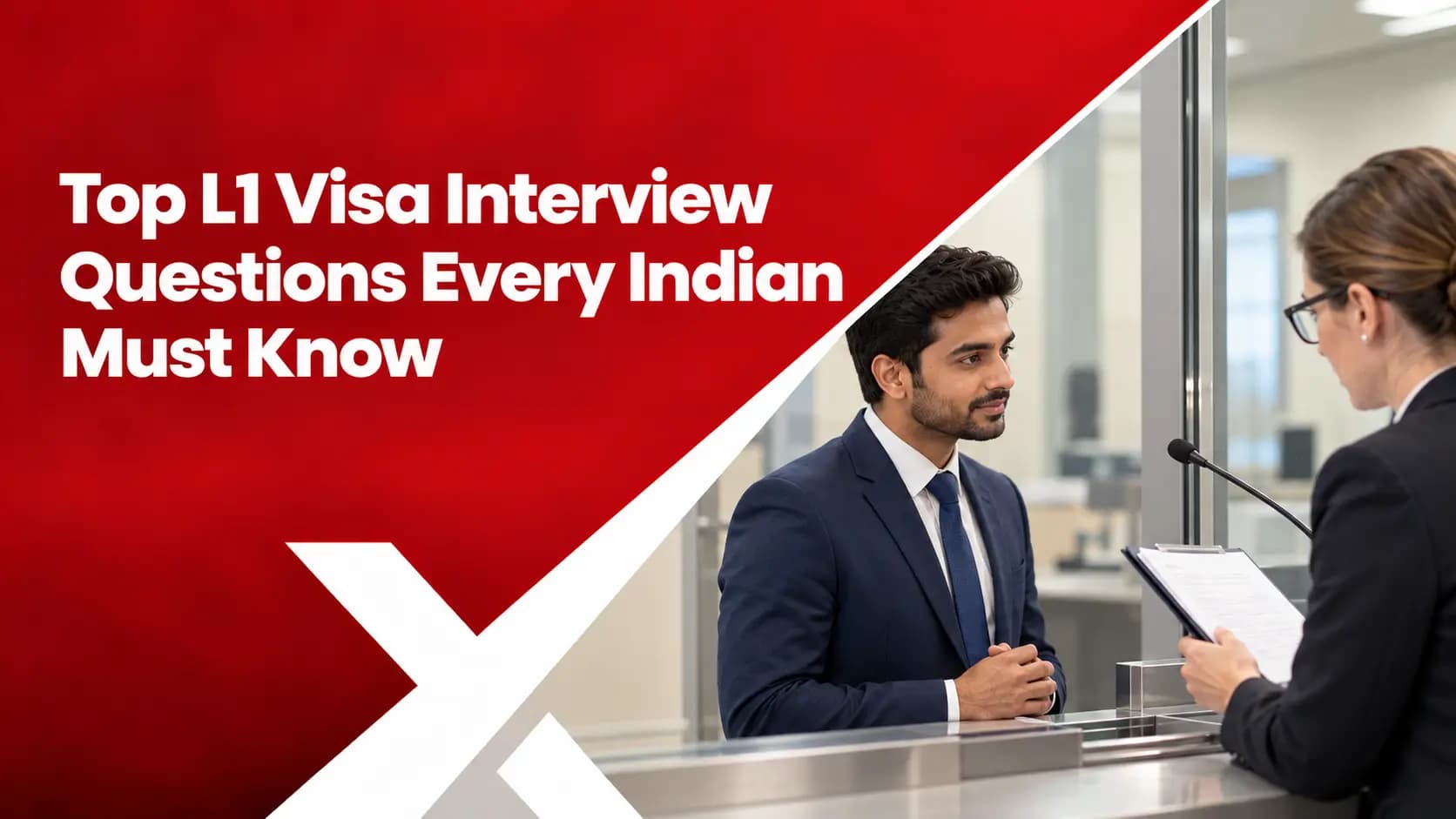
During the visa interview, you usually move from the waiting room to the office of an immigration officer or interview window. The officer asks short interview questions to confirm your identity, job details, employer information, and planned assignment in the United States.
| Stage | What usually happens |
| Before appointment | Complete DS-160 and carry the confirmation page |
| Arrival | Reach early and clear entry procedures |
| Waiting period | Sit in the waiting room until called |
| Interview | Answer questions from the consular officer clearly |
| Final step | The officer decides whether the visa can be approved |
Essential Documents for Your L1 Visa Interview
Your L1 visa interview is not only about answering interview questions well. It is also about showing complete, organized records that support your transfer. Missing paperwork can slow a legal process that already requires careful timing.
Bring documents that prove identity, petition approval, employment history, and your company relationship with the U.S. entity. The paperwork should support everything you say in the interview. The checklist below will help you see what matters most before your appointment.
Required Paperwork Checklist for L1 and L2 Applicants
Before entering the consulate or waiting room, make sure your file is complete. A visa applicant should carry the core identity and petition documents, along with records that support the transfer and show a valid company relationship.
Use this checklist as a practical starting point for your visa interview:
- Appointment letter for the L1 visa interview
- DS-160 confirmation page and fee receipt
- Valid passport, plus any old passports
- Copy of the L1 petition and Form I-797 approval notice
- Resume or CV, tax records, and recent bank statements
- Employer letter requesting the interview and describing the role
- Proof of 12 months of employment, qualifications, and relevant work experience
If L2 family members are applying, they should also carry their own passports and relationship evidence, such as a marriage certificate. Keep everything ready before your name is called so you do not have to search through papers under pressure.
Tips on Organizing and Presenting Your Documents
A strong file makes the visa interview smoother. When your documents are neatly arranged, you can answer interview questions faster and avoid confusion. This matters because a messy presentation can create a negative impression even when your case is valid.
Try a simple system that supports the legal process and helps you stay calm:
- Place identity, DS-160, and appointment papers at the front
- Group employer records, petition papers, and approval notices together
- Keep financial and employment history documents in a separate section
- Carry relationship evidence separately if dependents are attending
Just as important, only hand over what is requested. Speak clearly, pause before answering, and match your documents to your words. If you cannot find a paper quickly, you may appear unprepared. Good organization helps you look credible and keeps the interview moving.
Common L1 Visa Interview Questions for Indian Applicants
Most L1 visa interview questions are direct and job-focused. You can expect the officer to ask about your employer, your experience, your salary, your travel history, and the work you will do in the United States. The questions are meant to verify facts, not confuse you.
The officer’s goal is usually to confirm that your story matches the petition and that you meet the visa requirements. In the next two sections, you will see the common areas officers often focus on during these interviews.
General Questions Asked by L1 Visa Officers
In many cases, the consular officer starts with basic background questions. These help confirm your identity, travel history, and the type of visa you are seeking. The opening part of the visa interview is often brief, but it sets the tone.
Common interview questions may include:
- Which visa are you applying for?
- Have you been to the United States before, and when?
- When did you last return to India?
- Can I see your passport and petition papers?
- Can I see your visa fee receipt?
After that, the officer may move quickly into employment details. Answer in a calm and direct way. Do not add extra facts unless they help explain the point. Clear, short responses usually work best, especially when the questions are simple and factual.
Questions About Your Indian Employer and US Office Transfer
This part of the visa interview often matters the most. The officer wants to understand your current employer in India, the U.S. entity, and the business ties between them. As a visa applicant, you should be ready to explain the transfer in practical terms.
Questions often focus on your work history and the transfer itself:
- Which company do you work for, and how long have you been there?
- What is your role, salary, and who are your clients or customers?
- What is the name of the U.S. office, and what kind of organization is it?
- Why is your transfer necessary instead of assigning the work locally?
You may also be asked about reporting lines, job duties, and whether the work can be done from India. Keep your answers consistent with the petition. If the company relationship and business ties are clear, your case becomes easier for the officer to assess.
L1A Visa-Specific Interview Questions
Yes, there are different questions for L1A and L1B cases. In an L1A visa interview, the focus shifts to managerial skills, authority, and decision-making power. Officers want to know whether you truly work at a managerial or executive level.
That means your interview questions may go beyond titles and look closely at hiring power, reporting structure, and business decisions. If your employer or managing attorney has helped you prepare, use that guidance to frame clear, role-based answers.
Managerial Role and Responsibilities Discussion
For L1A applicants, the visa interview often examines whether you actually manage people, functions, or operations. A title alone is not enough. You should be ready to explain your daily responsibilities in a way that shows real managerial skills.
Officers may ask about your budget authority, your role in hiring and firing, and how many employees report to you. They may also ask when you last hired someone or what steps your company follows when an employee must be terminated. These questions test whether you understand the process because you actively lead it.
Another common theme is whether your transfer is in the best interest of the organization. You may need to explain why your presence in the United States is necessary, what team you will supervise, and how your decisions affect company operations on a larger scale.
Proving Executive Functions During the Interview
Executive-level L1A cases require more than routine supervision. During the visa interview, you may need to show that your proposed role involves broad authority, limited supervision, and influence over major business decisions. This is where many applicants need precise examples.
A useful approach is to describe how you guide teams, approve budgets, or shape policy rather than simply complete individual tasks. If people report to you in India or will report to you in the United States, explain that structure clearly. Numbers help, but responsibilities matter even more.
Keep your answers tied to the proposed role listed in the petition. Show how your managerial skills fit the U.S. assignment and why your transfer supports the company’s needs. When your explanation is specific, the officer can better see the executive nature of your position.
L1B Visa-Specific Interview Questions
L1B cases are different from L1A cases because the visa interview centers on knowledge, not leadership level. Officers look at your special skills, your area of specialization, and how your expertise supports the company’s operations in the United States.
Among the different categories of L1 applicants, L1B workers often need to explain technical or company-specific knowledge in simple language. The next sections cover how to present that knowledge and how to explain differences between your India role and U.S. assignment.
Demonstrating Specialized Knowledge in Your Field
In an L1B visa interview, you should expect detailed questions about what makes your work unique. Officers may ask about your area of specialization, how long you have worked in it, and why your special skills are important to the employer’s business.
Some officers may have extensive domain knowledge of your area of specialization, so vague answers can hurt your case. At the same time, heavy jargon does not help. The best approach is to explain your knowledge in plain English and connect it to the company’s operations, products, or internal systems.
You may also be asked why a U.S. worker cannot easily perform the role. Stay factual. Explain your training, company-specific experience, and how your knowledge supports the transfer. The goal is to show depth without sounding rehearsed or overly technical.
Addressing Job Role Differences Between India and the US
It is common for officers to compare your current employment in India with the role you will take in the United States. They want to see whether the move is logical and whether the duties still fit the L1 category. This is especially important in L1B cases.
Be ready to explain how your job role may change in scope, location, or team structure while still relying on the same core expertise. If the foreign company trained you on a process, tool, or internal method, explain how that background will be used in the U.S. office.
You may also need to say why the work cannot simply remain in India. Keep the answer focused on business need, operational value, and your specific knowledge. A clear comparison between both roles helps the officer understand why the transfer is justified.
Dependent and Spouse (L2) L1 Visa Interview Questions
If your spouse or children are applying as visa beneficiaries, they may also face questions during the visa interview. These questions are usually simple and focus on family and relationship details rather than technical job matters.
For most L2 applicants, the officer wants to confirm that the dependent connection is genuine and matches the records. That means your spouse should be prepared to answer basic personal questions confidently and consistently. The next sections outline what usually comes up.
Questions Spouses May Face During L2 Interviews
In business immigration cases, an L2 spouse usually receives straightforward questions. The officer is not testing technical knowledge. Instead, the visa interview is used to confirm the relationship between the principal applicant and each visa beneficiary.
Common questions for a spouse may include:
- How did you meet, and when did you get married?
- Where do you live together?
- Do you have children together?
- Can you provide your marriage certificate or photos together?
Sometimes the officer may also review whether the principal applicant is working under a valid company transfer, but the focus stays on the relationship. Questions about a green card holder are not the core issue here. Consistency, calm answers, and proper documents usually matter the most.
Responding to Family and Relationship-Related Inquiries
Family questions in a visa interview are usually simple, but they still need careful answers. A visa applicant and spouse should review key dates, living arrangements, and documents before the appointment. Small differences in answers can create confusion that is easy to avoid.
The best approach is to answer naturally and stick to the truth. If the officer asks when you married, where you live, or whether you have children, reply directly. If a document is requested, provide it without rushing. Overexplaining can sometimes create a negative impression.
It also helps if both spouses understand the principal L1 case at a basic level. While the focus is family and relationship details, each answer should still fit the broader application. Clear, matching responses make the interview easier for everyone involved.
Conclusion
Navigating the L1 visa interview process is crucial for Indian applicants aiming to transfer to the U.S. Understanding the types of questions you may face can significantly enhance your confidence and preparedness. From general inquiries about your role and employer to specific questions targeting your managerial or specialized knowledge, being well-prepared will make a substantial difference. Remember, clarity in presenting your documentation and a thorough understanding of your responsibilities are key. As you embark on this journey, take the time to review these common questions and formulate thoughtful responses. If you need personalized assistance, don’t hesitate to reach out for a free consultation. Your successful interview starts with being informed and ready!
Frequently Asked Questions
What should I do to prepare for an L1 visa interview in India?
Prepare for your visa interview by reviewing common interview questions, organizing your documents, and understanding your company relationship with the U.S. entity. If available, attend a mock or real interview practice session. You can also speak with an immigration attorney to make sure your answers match the petition.
Are there major mistakes to avoid during the L1 visa interview process?
Yes. Do not lie, interrupt, arrive late, or give answers that conflict with your records during the visa interview. These mistakes can create a negative impression and may have serious consequences. Remember, the officer’s goal is to verify facts, so honest, calm answers are always the safer choice.
How long does the L1 visa interview usually take for Indian applicants?
The actual L1 visa interview is often short, though your total time at the consulate may be longer because of the waiting room and entry procedures. During consular processing, the consular officer may ask only a limited number of interview questions, but you should still be fully prepared.

