

For entrepreneurs, investors, and established business owners, entering the United States can create opportunities for business expansion, investment, and long-term immigration planning. However, purchasing a U.S. business or making an investment does not automatically result in a Green Card or U.S. citizenship.
The US Green Card by Investment route most commonly refers to the EB-5 Immigrant Investor Program. However, entrepreneurs may also explore other immigration categories depending on their nationality, business structure, professional background, existing foreign company, investment plans, and long-term objectives.
Options such as EB-5, E-2, L-1A, L-1B, EB-1C, EB-1A, EB-2 NIW, and International Entrepreneur Parole serve different purposes. Some are immigrant pathways that can lead to permanent residence, while others are temporary or parole-based options.
Understanding these differences before investing in or acquiring a U.S. business can help entrepreneurs make better-informed decisions.
What Is a U.S. Green Card by Investment?
The term US Green Card by Investment generally refers to an immigration strategy where qualifying investment activity can support an application for U.S. permanent residence.
For anyone researching permanent residency options, a Green Card USA Complete Guide should distinguish between immigrant investment categories and temporary business or investor visas.
The primary investment-based immigrant category is EB-5 . Unlike temporary investor or business visas, EB-5 is designed as an immigrant pathway. However, eligibility depends on meeting specific investment, employment, source-of-funds, documentation, and other immigration requirements.
This means that an investor should not assume that simply buying an established U.S. business will result in permanent residence.
The business transaction and immigration strategy should be evaluated separately and then considered together as part of an overall plan.
Major U.S. Investor and Entrepreneur Immigration Options
Different categories may apply to different types of entrepreneurs and investors:
| Category | Main Purpose | Direct Green Card? |
| EB-5 | Investment and qualifying job creation | Yes, potentially |
| E-2 | Investment and operation of a U.S. business | No |
| L-1A | Transfer of executives/managers | No, but may connect to EB-1C |
| L-1B | Transfer of specialized-knowledge employees | No |
| EB-1C | Multinational executives/managers | Yes, potentially |
| EB-1A | Extraordinary ability | Yes, potentially |
| EB-2 NIW | Qualifying professionals/entrepreneurs | Yes, potentially |
| International Entrepreneur Parole | Certain qualifying startup founders | No |
The appropriate category depends on the applicant rather than simply the amount of available capital.
EB-5 Immigrant Investor Program
The EB-5 program is the most established U.S. investment-based immigrant pathway.
Under the current framework, qualifying investors generally need to invest:
- $1.05 million in a standard qualifying investment, or
- $800,000 in a qualifying targeted employment area or qualifying infrastructure project.
The investment must be made in a qualifying commercial enterprise and generally result in the creation of at least 10 permanent full-time jobs for qualifying U.S. workers .
An investor must also establish the lawful source and path of the invested capital and satisfy the other applicable EB-5 requirements.
Therefore, an us investment Green Card strategy involves much more than meeting a minimum investment amount.
EB-5 and Business Acquisition
An established U.S. business can potentially be relevant to an EB-5 strategy, but the transaction must be structured to satisfy the applicable EB-5 requirements.
Before acquiring a business, investors should examine:
- Financial statements
- Business valuation
- Existing employees
- Job creation potential
- Liabilities
- Tax records
- Contracts
- Source of funds
- Business structure
- Future growth plans
Commercial due diligence and immigration analysis should be completed before the investment is finalized.
E-2 Treaty Investor Visa
The E-2 Treaty Investor classification is designed for eligible nationals of countries that maintain the required treaty relationship with the United States.
An E-2 investor must generally make a substantial investment in a real and operating U.S. enterprise and develop and direct the business. The U.S. Department of State states that the investment must be substantial and sufficient to support the successful operation of the enterprise.
Unlike EB-5, E-2 does not have the same fixed statutory investment threshold.
However, E-2 is a nonimmigrant classification and does not itself provide a Green Card .
This distinction is important for entrepreneurs whose objective is permanent residence rather than temporary business operation.
E-2 and Indian Entrepreneurs
Indian entrepreneurs should pay particular attention to the nationality requirement. The Department of State’s current treaty-country list does not list India as an E-2 treaty country, and its India reciprocity page identifies E-2 as having “No Treaty.”
Therefore, an Indian national should not assume that purchasing a U.S. business automatically creates E-2 eligibility.
L-1A and L-1B for International Business Expansion
For entrepreneurs who already operate a business outside the United States, L-1A and L-1B can be important business-expansion pathways.
L-1A
L-1A is designed for qualifying executives and managers transferring from a related foreign organization to a U.S. entity. It can be relevant when an established international company wants to:
- Establish a U.S. office
- Expand existing operations
- Transfer an executive or manager
- Manage a qualifying U.S. business
L-1A does not require a specific investment amount like EB-5.
For eligible applicants, an L-1A visa may also form part of a longer-term L1 visa to Green Card strategy, depending on the applicant’s circumstances and eligibility for an appropriate immigrant category.

L-1B
L-1B is intended for qualifying employees with specialized knowledge who transfer from a related foreign organization to a U.S. entity. It may be useful when a company needs employees who have specialized knowledge of its products, services, systems, technology, processes, or procedures.
L-1B also does not require a fixed investment amount.
Neither L-1A nor L-1B directly provides permanent residence. However, qualifying L-1A executives and managers may potentially pursue EB-1C as a later immigrant pathway. The availability of this pathway depends on meeting the applicable requirements.
EB-1C for Multinational Executives and Managers
EB-1C is an immigrant category for qualifying multinational executives and managers.
It can be particularly relevant to business owners who already operate an established company outside the United States and develop a qualifying U.S. business operation.
A qualifying applicant generally needs appropriate multinational employment experience and a qualifying U.S. employer relationship. The U.S. Department of State describes EB-1C as covering multinational managers and executives who have qualifying overseas employment and are coming to work in a qualifying managerial or executive capacity in the United States.
For some business owners, an international expansion strategy can therefore involve:
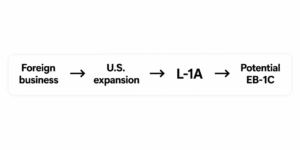
However, L-1A approval does not guarantee EB-1C approval. Each category has its own requirements.
EB-1A for Entrepreneurs With Extraordinary Ability
Investment is not the only potential route to permanent residence.
EB-1A may be relevant to individuals who can demonstrate extraordinary ability in areas such as business, science, education, arts, or athletics.
For entrepreneurs, evidence may potentially include significant professional achievements, recognition, awards, media coverage, publications, leadership, judging, or other qualifying evidence.
Unlike EB-5, EB-1A does not require a fixed investment amount.
The category is highly fact-specific, so professional immigration assessment is important before pursuing this strategy.
EB-2 National Interest Waiver
The EB-2 National Interest Waiver (NIW) can be another potential immigrant pathway for qualifying professionals and entrepreneurs.
Unlike EB-5, the NIW does not require a fixed investment.
Applicants generally need to qualify for the underlying EB-2 classification and then satisfy the requirements for a National Interest Waiver.
Entrepreneurs may consider this option when their proposed work in the United States could potentially satisfy the applicable national-interest requirements.
The U.S. Department of State notes that qualifying EB-2 applicants may seek an exemption from the job-offer and labor-certification requirements through a National Interest Waiver when the exemption is in the national interest.
International Entrepreneur Parole
The International Entrepreneur Parole program is designed for certain startup founders who meet specific requirements relating to their startup, ownership, investment or government awards and grants, and role in the company.
USCIS periodically adjusts the relevant investment and award thresholds under the program.
International Entrepreneur Parole is not a Green Card . It is a parole mechanism that may allow qualifying entrepreneurs to remain in the United States temporarily while developing their startup.
This option is therefore different from EB-5 and other immigrant categories.
Buying an Established U.S. Business
Foreign entrepreneurs can explore acquiring established businesses in the United States .
An existing business can provide advantages such as:
- Established customers
- Existing revenue
- Employees
- Supplier relationships
- Operating history
- Existing infrastructure
- Market presence
However, the acquisition should be evaluated from both commercial and immigration perspectives.
Important considerations include the company’s financial health, valuation, liabilities, contracts, employees, licenses, business location, source of investment funds, and the investor’s intended role.
A business that is commercially attractive may not necessarily fit the requirements of a particular immigration category.
Similarly, an immigration strategy should not be used to justify an otherwise unsuitable business investment.
US Green Card With Investment: What Should Investors Consider?
Anyone researching a US Green Card with investment should look beyond the investment amount.
Important considerations can include:
Source of Funds
Investment capital may need to be supported with documentation demonstrating how the funds were legally obtained and transferred.
Business Structure
The ownership and operating structure can affect immigration eligibility.
Job Creation
Job creation is particularly important for EB-5 investors.
Business Role
The investor’s actual role in the company can be important for categories such as E-2 and L-1A.
Foreign Company
An existing overseas company may create opportunities for business-expansion categories such as L-1A, L-1B, and potentially EB-1C.
Long-Term Objective
An entrepreneur seeking temporary business operation may have different options from an entrepreneur whose primary objective is permanent residence.
American Green Card by Investment and Permanent Residence

The phrase american Green Card by investment can sometimes create the impression that a specific payment automatically results in permanent residence.
That is not how the U.S. immigration system works.
A qualifying investment may form part of an immigrant petition, but approval depends on satisfying the requirements of the relevant category.
For EB-5, this includes investment, qualifying employment creation, source and path of funds, and other requirements.
Other immigrant categories, such as EB-1A, EB-1C, and EB-2 NIW, are based on different eligibility standards and do not require the EB-5 investment amount.
US Permanent Residency by Investment vs. U.S. Citizenship
US permanent residency by investment and U.S. citizenship are not the same.
A qualifying immigrant pathway can potentially lead to lawful permanent residence. Citizenship is a separate process with its own eligibility requirements.
Therefore, the phrase us citizenship investment should be used carefully. There is no simple investment that automatically grants U.S. citizenship.
A simplified progression may look like:
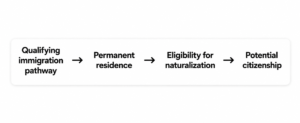
Qualifying immigration pathway → Permanent residence → Eligibility for naturalization → Potential citizenship
The timing and requirements depend on the individual’s circumstances.
U.S. Immigration Planning for Indian Entrepreneurs
Indian entrepreneurs often consider the United States for market expansion, business acquisition, investment, and international growth.
However, nationality can affect which immigration categories are available.
For example, E-2 eligibility requires treaty-country nationality, and India is currently not listed as an E-2 treaty country.
Established Indian business owners may therefore need to evaluate other options, such as L-1A, L-1B, EB-1C, EB-5, EB-1A, or EB-2 NIW, depending on their individual circumstances.
This is one reason immigration planning should begin before purchasing or restructuring a U.S. business.
Which U.S. Immigration Option May Fit?
A simplified comparison can help:
EB-5: For qualifying investors seeking an investment-based immigrant pathway.
E-2: For eligible treaty-country nationals investing in and operating a U.S. business.
L-1A: For qualifying executives and managers transferring from an overseas company to a related U.S. entity.
L-1B: For qualifying specialized-knowledge employees transferred to a related U.S. entity.
EB-1C: For qualifying multinational executives and managers seeking an immigrant pathway.
EB-1A: For individuals who meet the extraordinary-ability requirements.
EB-2 NIW: For qualifying professionals and entrepreneurs who may satisfy the National Interest Waiver requirements.
International Entrepreneur Parole: For certain qualifying startup founders.
The correct strategy depends on the person’s business, investment, professional qualifications, nationality, family situation, and long-term goals.
How Phoenix Business Advisory Supports Entrepreneurs
Phoenix Business Advisory helps entrepreneurs and investors explore U.S. business opportunities, acquisitions, investment planning, and international expansion.
Support may include:
- U.S. business opportunity evaluation
- Business acquisition planning
- Investment structure evaluation
- Commercial due diligence considerations
- U.S. market-entry planning
- International business expansion
- Coordination of business objectives with immigration planning
Phoenix Business Advisory does not replace qualified immigration counsel. Immigration eligibility, legal interpretation, petition preparation, and representation should be handled by an appropriately qualified U.S. immigration attorney.
The goal is to help entrepreneurs evaluate both sides of a major decision: whether the U.S. business opportunity makes commercial sense and whether its proposed structure may align with the entrepreneur’s long-term objectives.
Any Green card approval remains subject to the applicable immigration requirements and the decision of the relevant U.S. immigration authorities. No business investment or advisory service should be presented as a guarantee of Green Card approval .
Frequently Asked Questions
Can I get a U.S. Green Card by buying a business?
Not automatically. Buying a business does not itself create Green Card eligibility. The transaction must satisfy the requirements of a specific immigration category.
What is the main investment-based Green Card program?
EB-5 is the primary U.S. immigrant investor program. It requires qualifying investment, job creation, source-of-funds documentation, and other requirements.
How much investment is required for EB-5?
The current framework generally requires $1.05 million for a standard investment or $800,000 for a qualifying targeted employment area or infrastructure investment.
Is E-2 the same as EB-5?
No. E-2 is a nonimmigrant treaty-investor classification, while EB-5 is an immigrant investor category.
Can L-1A lead to permanent residence?
Potentially. Qualifying multinational executives and managers may explore EB-1C, although L-1A approval does not guarantee EB-1C approval.
What is the difference between L-1A and L-1B?
L-1A is for qualifying executives and managers. L-1B is for qualifying employees with specialized knowledge.
Do all U.S. investor visas lead to a Green Card?
No. E-2, L-1A, L-1B, and International Entrepreneur Parole do not directly provide permanent residence.
Is U.S. citizenship granted after an investment?
No. Investment does not automatically provide citizenship. Permanent residence and naturalization are separate immigration stages.
Can Indian entrepreneurs explore U.S. immigration options?
Yes. Multiple categories may be relevant depending on individual circumstances, but E-2 eligibility is restricted by treaty-country nationality and India is not currently an E-2 treaty country.

